
This selection comes to you from 3 thought daughters who, for better or worse, chose language as a way to make sense of themselves and the world around them. In 2025, that meant a lot of reading. On the go, in bed, in between life happening.
These are the books that struck us, touched us, distracted us at the right moment, or taught us something along the way. Some stayed with us for weeks, others changed how we think about love, grief, friendship, or ourselves. None of them were accidental.
Consider this the library of our year.
And your nudge to pick up a book.
List by Awa Anne, Nanuka Jorjadze and Zaina Pakabomba
Nanuka’s Reads
The year unfolded between departures and arrivals; I spent most of it in transit, avoiding stillness and calling it curiosity. Unsurprisingly, I fell for books that refused to play along. No reinvention arcs, just aftermaths, fractures, and emotions unraveling slowly and on purpose. Low plot, high emotional damage: books that made sense of a life that wouldn’t slow down.
Morning and Evening — Jon Fosse
A life reduced to its quiet thresholds: birth, death, and the almost-silence in between. Fosse writes in spare, looping sentences that feel like breathing: hypnotic, repetitive, inevitable. Nothing happens, yet everything does. A book about presence, absence, and the strange calm of existing at all.
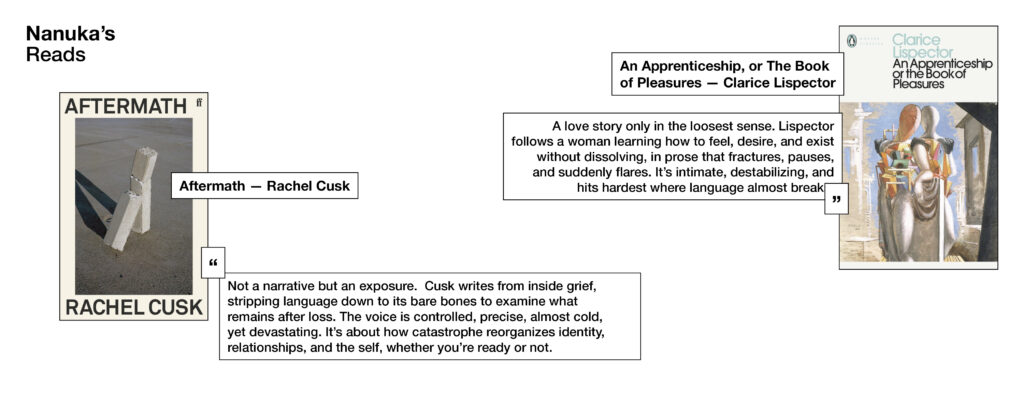
Not a narrative but an exposure. Cusk writes from inside grief, stripping language down to its bare bones to examine what remains after loss. The voice is controlled, precise, almost cold, yet devastating. It’s about how catastrophe reorganizes identity, relationships, and the self, whether you’re ready or not.
An Apprenticeship, or The Book of Pleasures — Clarice Lispector
A love story only in the loosest sense. Lispector follows a woman learning how to feel, desire, and exist without dissolving, in prose that fractures, pauses, and suddenly flares. It’s intimate, destabilizing, and hits hardest where language almost breaks.
A coming-of-age story stripped of comfort. In a landscape bleached by sun and salt, Levy explores dependency, female rage, and the uneasy pull of desire. Her prose is lean and destabilizing, attentive to the body and its failures, to language and its limits. The novel asks what it costs to be free when your life has been shaped by someone else’s need and whether escape is ever clean.
Drive Your Plow Over the Bones of the Dead — Olga Tokarczuk
A murder mystery that’s not really about murder. Set in a remote Polish village, the novel follows an eccentric, furious woman who sees the world through astrology, poetry, and moral absolutism. Tokarczuk blends dark humor, ecological rage, and philosophical inquiry into a quiet revolt against human arrogance. Strange, unsettling, and deeply satisfying.
Awa’s Reads
2025 was a year of waxing and waning, of growth and retreat, expansion and contraction. Of shedding skin and realizing it was never truly yours to begin with, then finding comfort in what remained raw. The rawness of emotion, reaction, coping, feeling, joy, all of it. Let’s just say 2025 was a real one, and my favourite reads became a reflection of that. Back to the basics of what makes us human, searching for beauty in almost everything, and never, ever being afraid to feel.
Attached — Dr. Amir Levine and Rachel S. F. Heller
An easy, digestible read and highkey exactly what I needed at the time. It showed me that I actually knew far less about myself than I thought and taught me so much about my own patterns and tendencies in relationships. I’m usually not a self-help book person at all, but wow, this one really helped.
This book has been my companion since I turned 18, so consider this a lifetime favourite. It doesn’t offer answers so much as permission to move at your own pace, to wander, to doubt, to listen. Gentle, philosophical, and pacifying every single time.
The Book against Death — Elias Canetti
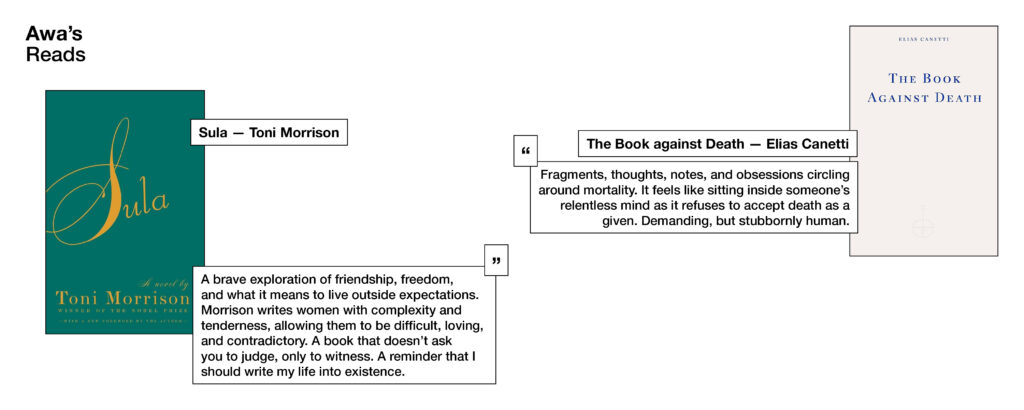
Fragments, thoughts, notes, and obsessions circling around mortality. It feels like sitting inside someone’s relentless mind as it refuses to accept death as a given. Demanding, but stubbornly human.
Rilke on Love — Rainer Maria Rilke
Rilke writes love as a force that asks everything of you, not something soft or ornamental but something vast, demanding, and sacred. He is a true proponent of love in all its depth and difficulty, and reading these poems gave me literal chills. They don’t comfort so much as they open you up, leaving your heart tender and awake long after.
A brave exploration of friendship, freedom, and what it means to live outside expectations. Morrison writes women with complexity and tenderness, allowing them to be difficult, loving, and contradictory. A book that doesn’t ask you to judge, only to witness. A reminder that I should write my life into existence.
Zaina’s Reads
Last year’s request for profound experience was answered. This year catapulted me into my own personal, cosmic system of unexpected joys, newness, vulnerability, and an intensity that I didn’t anticipate. Uncertainty was in the air, and so I held on tightly to good ideas, abandoned passivity, and fought hard to stay close to myself. Almost by accident, books appeared before me which shared feelings of grief, desire, curiosity, waiting and becoming.
This felt like being in someone’s live thoughts before they turn to language. Everything is immediate, fleeting, and vital. Lispector tries capturing the present moment (the it) through a spontaneous monologue about anything that occurs to her; from flowers, to the feeling of being born, to surviving uncertainty. She leaves no space between impulse and pen.
As I Lay Dying — William Faulkner
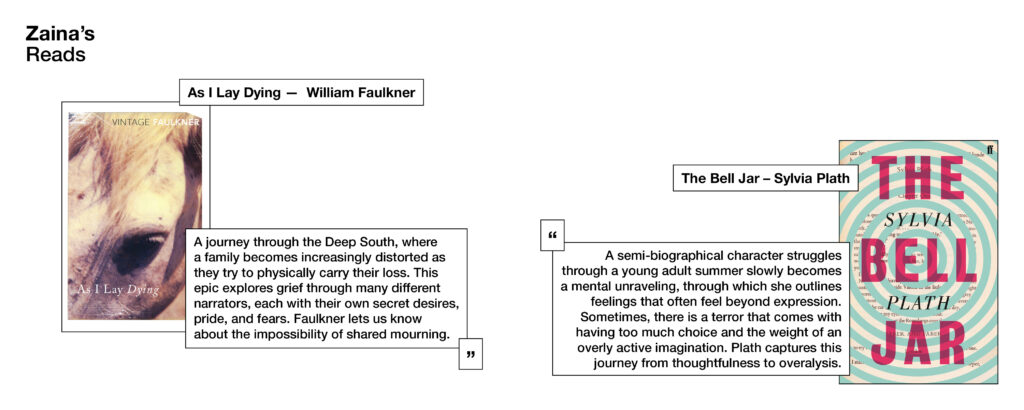
A story about a family carrying loss. Told through the private, fragmented thoughts of fifteen narrators. The language is grey, confessional, and of the Deep South. Reading this is like catching glimpses of something moving fast; and as meaning accumulates, you learn about the impossibility of shared mourning.
A Raisin in the Sun —Lorraine Hansberry
A family in Southside Chicago confronts financial and systemic limitations, and each member negotiates what they would do with a little more money. Through just a few breakfast-table arguments and brief introspections, you can feel the weight of their deferred dreams. It’s also the first play by a Black woman ever produced on Broadway (!)
A summer internship in 1950s New York slowly unravels a young woman’s mind as she struggles with choices of early adulthood. She overanalyses and captures feelings that are often beyond expression. Plath explores the terror of having too much choice, and the way imagination can flip into despair. And she is strikingly honest.
Wuthering Heights — Emily Bronte
A spiral into romance that is both brutal and mesmerizing. I first read this in a women’s studies class a few years ago, and recently returned to my reflections on it: a very haunting exploration of a love that never changes, and the ways it can consume those bound to it. Ghosts appear, the social self clashes with the loving self, and bittersweet revenge unfolds.