What does it mean to listen together in a world increasingly shaped by forced displacement and ongoing crises?
This question lies at the heart of Sonic Acts Biennial 2026, whose theme Melted for Love explores the fragile ways human beings remain connected to one another. Through performances, exhibitions, concerts, workshops, and artist talks, the festival invites audiences to consider how emotion, history, and collective memory travel through sound.
Among the artists performing this year is Laura Ortman, the White Mountain Apache violinist and composer whose work bridges experimental music, performance, and visual art. On Saturday March 28, at Singelkerk, Ortman will premiere a new live set as part of the concert As We Tremble, a program that examines how folk traditions carry histories that are rarely written down but instead passed through rhythm, breath, and vibration.
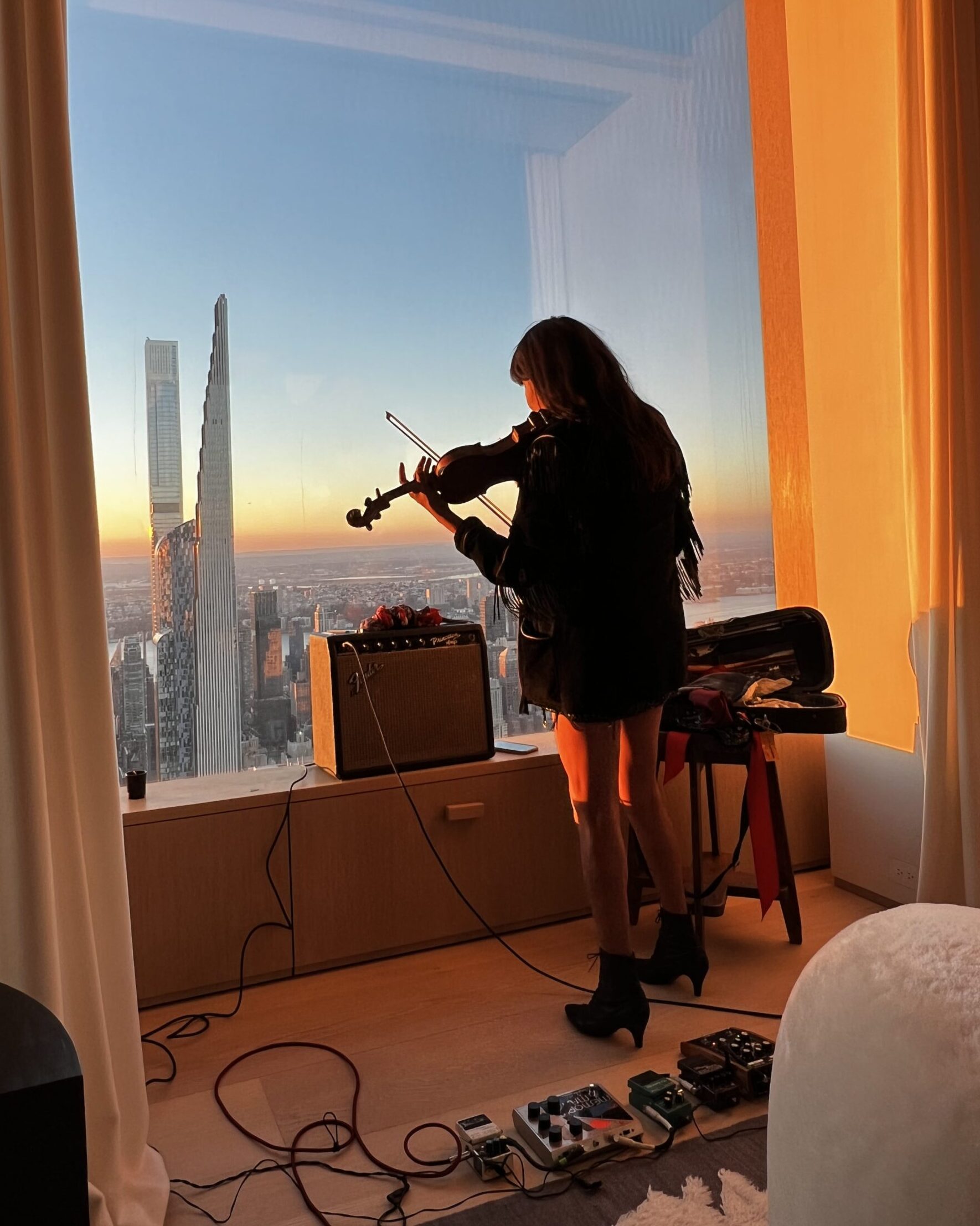
Ortman’s performances push the violin far beyond its classical origins. Using heavy amplification, whistles, bells, guitar picks, tuning forks, and branches, she creates dense sonic environments that feel both raw and immersive. In her hands, the instrument becomes a tool for exploring memory, ancestry, and the emotional textures that shape the human condition.
This approach mirrors the spirit of Melted for Love, which asks artists and audiences alike to reflect on the delicate threads that hold communities together even in moments of rupture or noise. Ortman’s work treats sound as a living archive, capable of carrying both personal and collective histories across time.
Ahead of her performance during Sonic Acts Biennial, we spoke with Laura about improvisation, collaboration, and the emotional landscapes hidden inside sound.
How are you today?
Pretty wildly good! Just got back from a festive rehearsal in San Francisco and played a set last night in Harlem! Spring is in the air!
You are arriving in Amsterdam to perform at Sonic Acts Biennial. What drew you to this project and this particular performance?
It’s been an honor to be asked to play this festival!
Your work moves between experimental sound, performance, and visual art. When did you first realize that sound could function as a form of storytelling?
I was making installation art and doing arty performances on my own when I started making sounds for these happenings and got completely absorbed in the textural impact and how sound enhanced that impact. That was the meaning of the 90’s for me. The good old non-confusing 90’s!
You often work with the violin in unconventional ways. When did the instrument begin to feel like an experimental tool rather than a classical one?
I’d say when I started making solo albums. As a one-woman band I had the option to pull as much out of the violin as I could. It’s always been MY violin, because it was made exclusively for me and it was a gift in 1991. So there’s nothing like it and I intend to personalize my sound with every morsel of rosin and strong, good smelling wood and metallic strings.
Your performances incorporate the Apache violin and draw from your White Mountain Apache heritage. How does ancestry shape the way you think about sound and composition?
I feel very at home where I’m from in Arizona so often I think of the distance from when I am away in New York or elsewhere and it gives this instinctual reverb in my head from the echoes off the canyons and mountains and vistas. It’s pure delight, because it is very beautiful where I am from and it informs how to communicate with the land and its memory.
In the programme text your upcoming performance is described as turning the violin into a ‘ferocious, rosin-soaked engine of smoke, dust, wind and grit.’ What world are you trying to create with this new set?
Hey, its Amsterdam! I’m a nutso New Yorker and feel a kinship with the urban grit of these places as much as possible. Our crazy histories, and people-crazed intricacies of living on top of each other literally. Its also a kiss to the natural habitats within and amongst all the water.”
Improvisation seems to play an important role in your performances. How much of your work is composed beforehand and how much emerges in the moment?
I began improvising mostly when I moved to NYC in 1997 and played with modern dancers. It was stretching out my vocabulary. So now when I’m in my studio and free, I take great care to see what happens and then install it in the memory bank.
Playing passages or transformations to death till they are ingrained in me like the back of my hand. So then when I am playing live, some of these passages get to see the light of day, but who knows when? Sometimes it just leans into me too or guides the way which often leaves me dumbfounded which I love. Its very serious and also very laughy. I love to play.
You work with a wide range of materials and instruments, from amplified violin and whistles to bells, branches, and tuning forks. What attracts you to these unconventional modes of making?
“Whatever fits into my case. Heh! Sometimes when I’m running out the door to the airport or soundcheck or studio I’ll grab a red lightbulb or a pinecone from my collection, or some guitar picks or put on some giant earrings…to see what happens. Being a one-woman band I like to keep things fascinating and unexpected.
“To decolonise the violin is to be the heart crying out loud in tears of joy.”
Your practice often feels very physical. Sound seems to move through the body as much as through the space. How do you think about the relationship between sound, movement, and the body?
I joined a gym four years ago to strictly learn how to properly swim. I am so proud to say that now i can swim laps for 45 minutes easily and then soak in the hot tub or sauna and reminisce how good it makes me feel. I get stressed when amongst big projects, money, dating, family, and all kinds of shit, so I use my body in swimming to clarify my energy. It totally works and I’d like to give myself a reward for figuring all this out on my own. Being underwater everything sounds different and it transfers ideas in such a peaceful way.
Many of your collaborations span music, visual art, and performance. What does collaboration unlock in your practice that solo work cannot?
Collaboration is key! I have some incredibly passionate relationships with these experts. It really transforms the sounds and opens up insights of how we navigate through this life. I have had a longtime collaborative crew with an indigenous filmmaker and ballet dancer and choreographer, Nanobah Becker and Jock Soto. We’ve made three videos together that has made our dream of making a triptych come true. Now we can finish each other’s sentences and make art and meals together.
“It’s one of the true delights in collaboration is all the good stuff around it. And way better than locking myself in my studio all lonely and stuff. Heh!”
Your performance at Singelkerk will take place inside a church. Does a space with that kind of historical and spiritual weight change the way you think about sound?
Funny enough, a couple years ago I swore off playing in churches. Yes I know…the acoustics, the acoustics, but I wanted things to be more accountable and the history of these churches make me feel something that I didn’t care to contribute to. Until my friend Raven Chacon asked me to play his incredible new work ‘Voiceless Mass’ in New York for the awesome amazing Ende Tymes noise festival headed by Bob Bellerue. Everything made sense to go back into the church and play with a realized purpose. So we all are friends now and I am now back into the acoustics, the acoustics, the acouuuuuuuustics of churches.
Looking ahead, what kinds of sonic worlds are you curious to explore next?
I am excited to be working on making another solo album. I have always made my solo albums with the great Martin Bisi in Gowanus, Brooklyn. His engineering wonders have created new sounds from my instrumentation and voice that I never knew were possible. It is one of my favorite experiences as an artist to create these albums. Collaboration is key! Plus it gives me a chance to move my Helpinstill Roadmaster 64 piano to his studio for half a year!
Sound, in Laura Ortman’s work, becomes a form of connection that moves through bodies and landscapes alike. A vibration capable of carrying memory, emotion, and history across time.
Laura Ortman performs during the concert As We Tremble on March 28 at Singelkerk, Amsterdam, as part of Sonic Acts Biennial 2026.