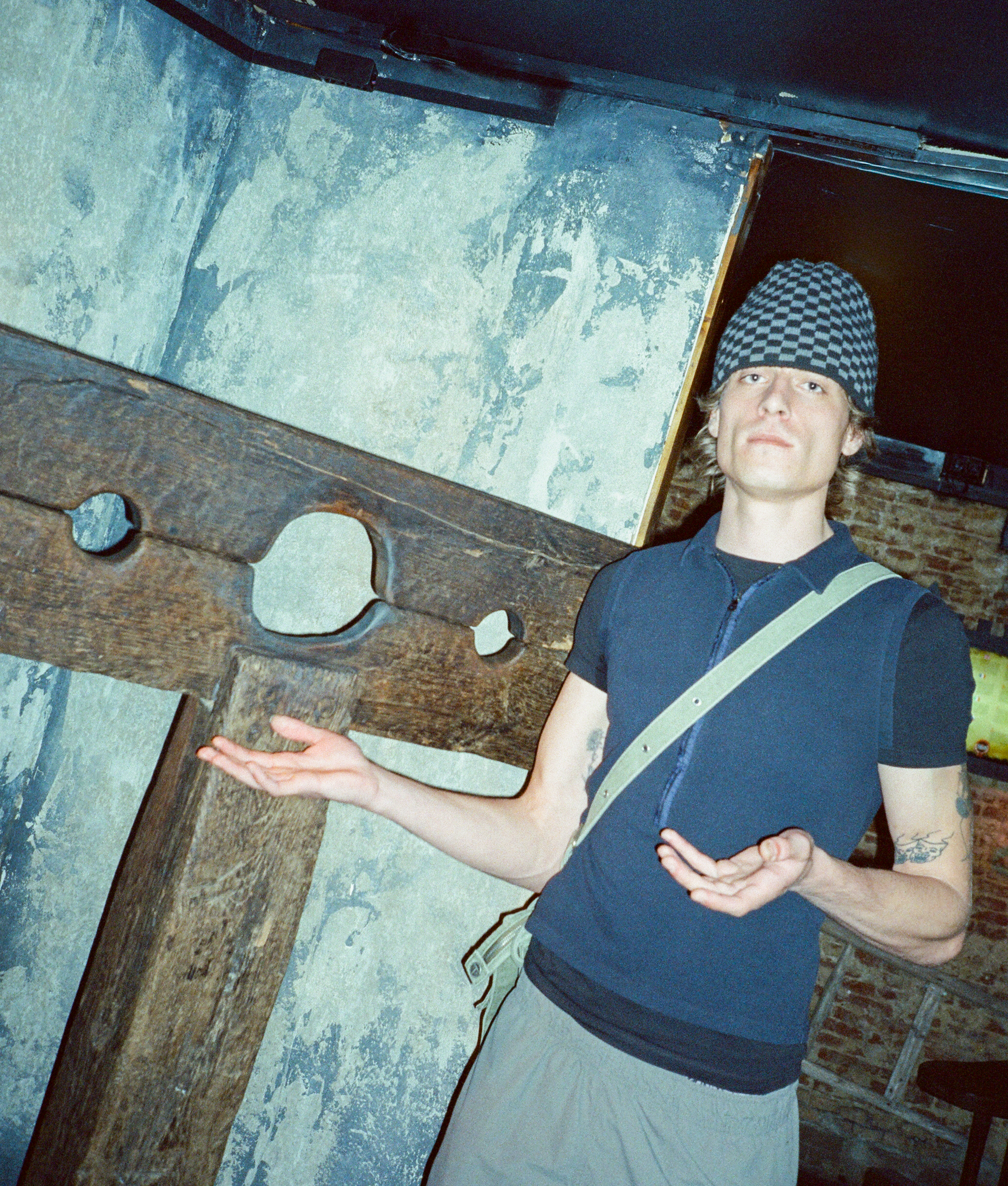
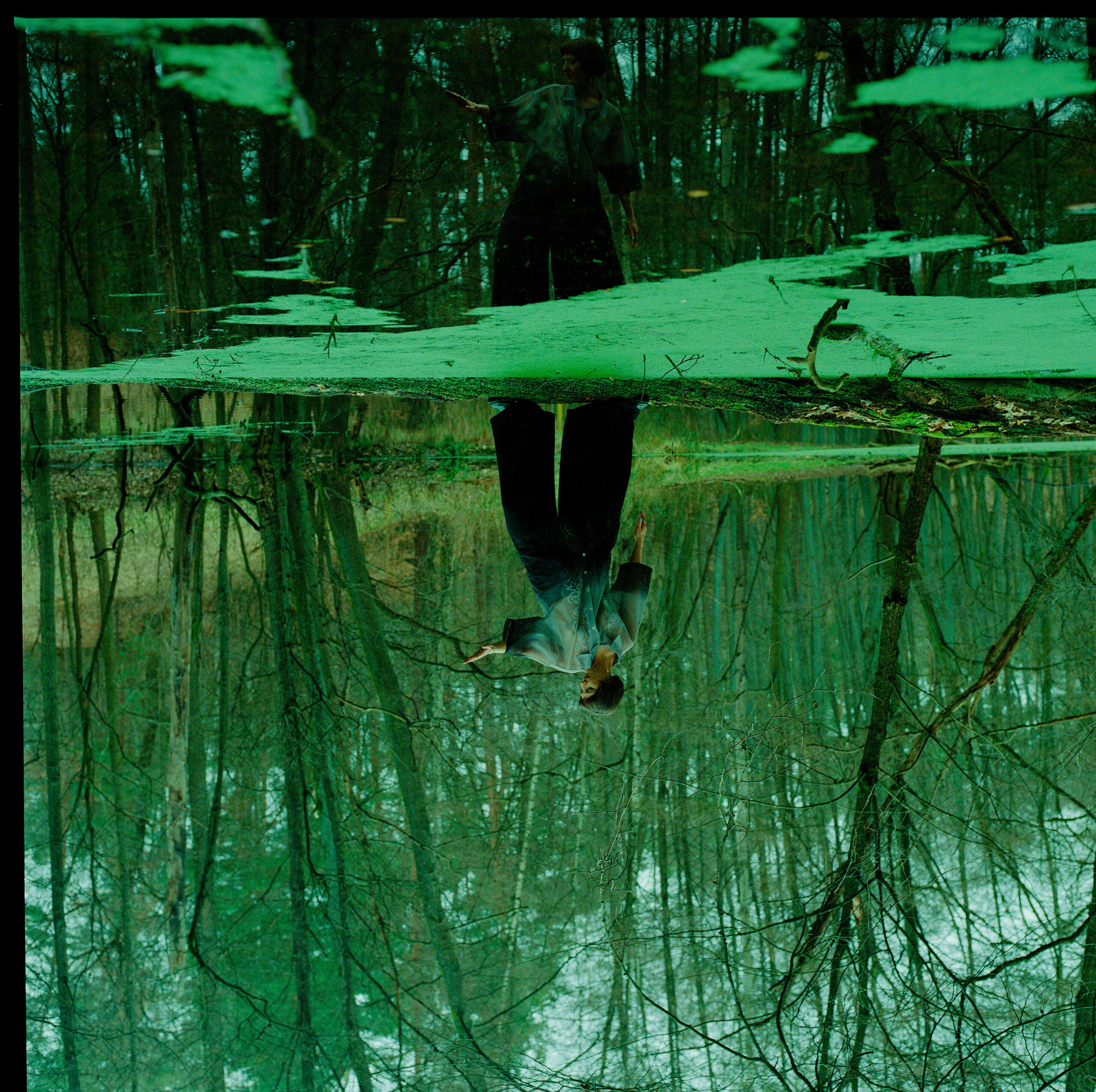
Madelyn Byrd recently relocated from Berlin to Marseille and is, by their own admission, currently obsessed with doing nothing. Not in a passive way. In the way of someone who has spent a long time paying very close attention to everything and has decided that stillness is itself a practice worth taking seriously. They avoid caffeine and screens for the first hour of every morning. They stare at the sky. They journal. They cuddle their cat. They are also, simultaneously, a sound artist, performer, DJ, educator, co-founder of the hydrofeminist label Gravity Pleasure, one third of spoken-word project Songs for the Crossing, one quarter of experimental quartet feu fou, and the recipient of a Musicboard Berlin scholarship for their forthcoming album Night Rider. The doing nothing is relative.
Under the name Slowfoam, Madelyn has spent over a decade building a practice that moves between field recording, bass territory, dronesque tapestries, and the somatic. Their acclaimed LP Transcorporeal Portal came out in 2024. They teach Sonic Worldbuilding courses. They think seriously about what it means to listen, to collaborate, and to imagine worlds other than the one we are currently stuck in.
They play FIBER Festival at TILLATEC on Saturday May 30th, opening the eleven-hour night. We spoke to them about worldbuilding, dissolving into each other, and what it actually means to let the weird out.
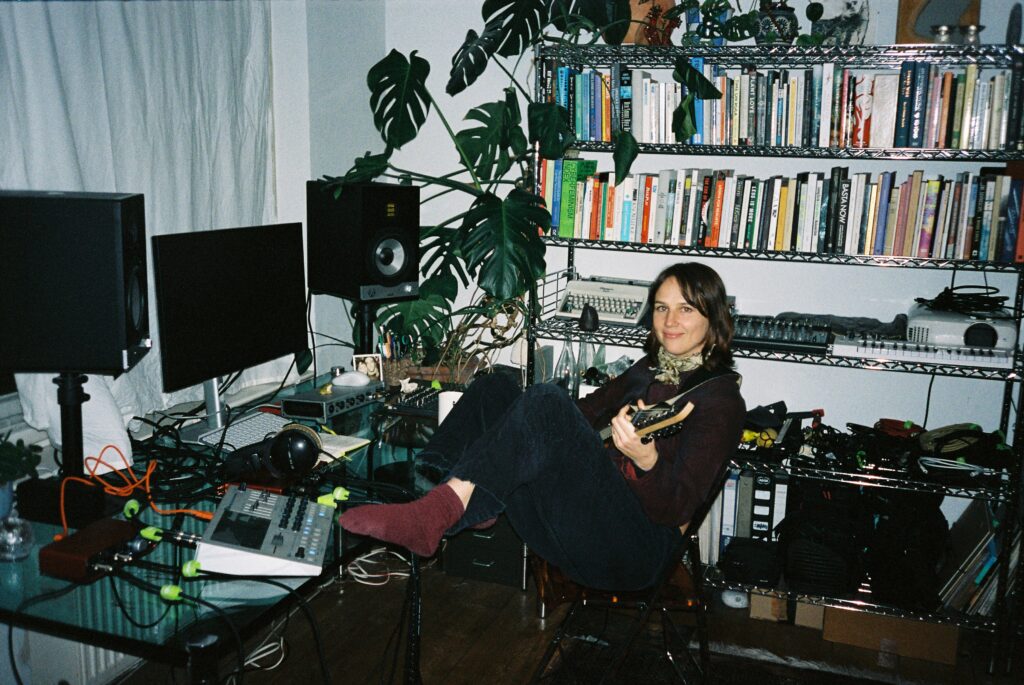
Awa: What does a regular morning look like for you when you are not performing or traveling?
Madelyn: I am very precious about mornings and use them as a grounding point for the day. I am a night owl, so they usually start late, after laying in bed for a bit reflecting on my dreams, cuddling my cat, and staring out the window. I am trying to avoid caffeine and screens for the first hour of the day, instead using this time to enjoy silence, stare at the sky, stretch, journal, and draw.
Is there something you have been completely obsessed with lately?
I have been obsessed with doing nothing. We are so overstimulated, I am really enjoying moments of stillness that allow me to actually hear beyond my thoughts and into my body and the surrounding environment.
Is this your first time at FIBER, and what is your relationship with Amsterdam?
This is my first time at FIBER, yes. I have been to Amsterdam a few times to play gigs with Subbacultcha, Decadance, and murmur, which have all been lovely. I am inspired by the music and art scene in Amsterdam, and I am looking forward to getting more acquainted with the communities behind it.
You hold a Masters in Neuroaesthetics from Goldsmiths, where you researched the impact of collaborative imagination on measures of connection and hope. How directly does that research live inside the music you make as Slowfoam?
My music practice is definitely connected to my masters, but less scientific and empirically-driven, which is liberating. My work as Slowfoam is always in relation to others. Collaboration holds the power to transform us, shake us out of old patterns, blur the lines around self and other, and reveal other ways of communicating and relating. It also reveals that creativity is greater than a series of internal decision-making processes. It is a force we can tap into and dialogue with, together. It can challenge and transform us.
You teach a course called Sonic Worldbuilding and Subversive Creative Practice. What does worldbuilding actually mean to you in a musical context?
Worldbuilding is an expansive framework to think about sound and creativity as holding an infinite array of possible forms. It holds the personal, political, and mythical with equal weight, and accepts that reality is a construct that is always in flux. Through shifting out of the illusion that this reality is fixed, we can access new vantage points, and from these, offer alternatives. When we imagine another world, we are in direct conversation with this one, engaging with it critically by amplifying or contrasting the positive or negative traits, and trying to understand the mechanisms that hold it together.
Sound is just another way to reimagine geologies, time, physical scale, power structures, voices, and modes of communication. And from these discoveries, perhaps we can connect the dots of change back to our present realities.
Your work moves through field recording, sound design, spoken word, and somatics. How do you know when a piece is finished?
I love weaving together different threads of texture into interesting timbral tapestries. Distinct sound sources on their own will always evoke specific feelings and memories, but once these origins are blurred, more obscure sounds and feelings begin to emerge. I will often swim around in this textural expanse exploring all the different possibilities for a while, obsessively. It is not uncommon for me to create and destroy several potential tracks in the process of making one. But each process is so different, and I try to listen and let my body and somatic responses lead the way, or let the track tell me when it is finished. It does not work every time, but I do my best to stop the process once it feels complete enough.
FIBER’s theme this year is Fragile Forces. What does fragility feel like to you in a room full of people?
I have been thinking about the inherent tension between fragility and force, but together they offer each other counterbalance and elasticity. Within a room full of people, I wonder if our own individuality can become fragile, instead using the music as a solvent for dissolving into each other.
A collective alchemy that ripples through and permeates us.
Sound as a fragile and impermanent force that still manages to leave resonating imprints on the collective body.
You describe your practice as decolonial and hydrofeminist. For people who are not familiar with those terms, how would you explain what they actually mean for the way you make and perform music?
Decoloniality is a framework for moving away from Eurocentric hierarchies and the lasting impact of colonisation, white-centric thinking, and imperialism, which also has ties to cis-white-hetero-patriarchal dogma. There is a lot packed into it. But essentially, I hope and believe we can all integrate disruption into our practice and communities and refuse to be governed by imperialist thought. Hydrofeminism and ecology offer a way to understand that we are very much connected to systems that go beyond us, beyond whiteness, beyond the patriarchy, and beyond the human.
In my sound practice, I incorporate these ideas in so many ways. I use sound as a mode for connecting disparate voices: human, non-human, technological, self, other, geology, creature, idea. They all get to belong in the creative realm. As someone who is queer and mixed race but white passing, it is also a personal space for interrogating my own internalised colonial and oppressive behaviours. Sound is a way to get back to the body, the subconscious, ancestry, and dreamspace. To recentre ideas that have been squandered by capitalist systems. We do not need to read academic texts to interrogate social and relational structures. We can also use sound and creativity for this work.
You are playing at TILLATEC during FIBER. How does the space change what you do?
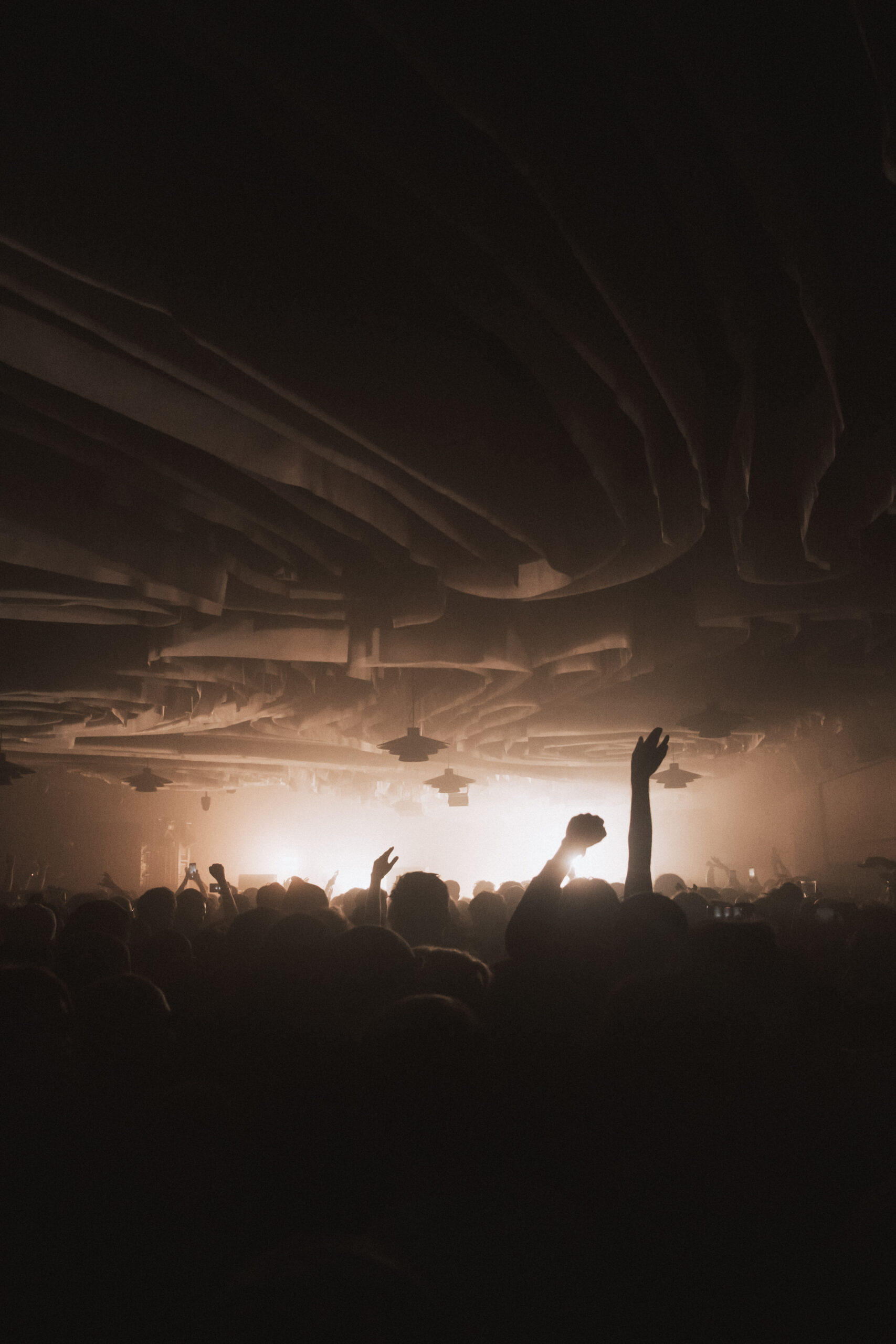
There is such a palpable energy to a space, even just the aesthetics and architecture, or the acoustics, that can impact how loud, noisy, or improvisational I feel the set can be. And then there is the audience, which amplifies these feelings. But I treat it as a soft collaboration and really enjoy attuning to the subtleties of the context I am performing in, and making decisions about how much I want to work within the present energy or challenge and change it.
What is one thing about the way our generation relates to sound and listening that gives you hope, and one thing that concerns you?
The way people are putting deep listening and sound at the forefront, listening to each other and the more-than-human realm, laying down to listen and feel in a shared listening environment, dancing and releasing together, or using sound as a device for signalling that this is a community you can relate to and belong to. This all gives me hope. The only thing that concerns me is our ability to put some of the insights that we gain from these experiences into practice in our day-to-day. No judgement, but I do hope these spaces can galvanise some bolder, courageous shifts in dismantling and changing the broken and toxic systems we live in.
One thing you are done keeping to yourself, and one thing you are still holding on to.
I am trying to just be a bit more open about how weird I am deep down. Letting the weird out and creating a space where others feel comfortable to do the same. I am still holding on to some self-doubt. Both will be a lifelong process.
Last message for the world?
Listen deeper, to others, to non-humans, your body, your history, your imagination, and boldly transform accordingly.
Slowfoam plays FIBER Festival at TILLATEC on Saturday May 30th, opening the eleven-hour night from 20:00.