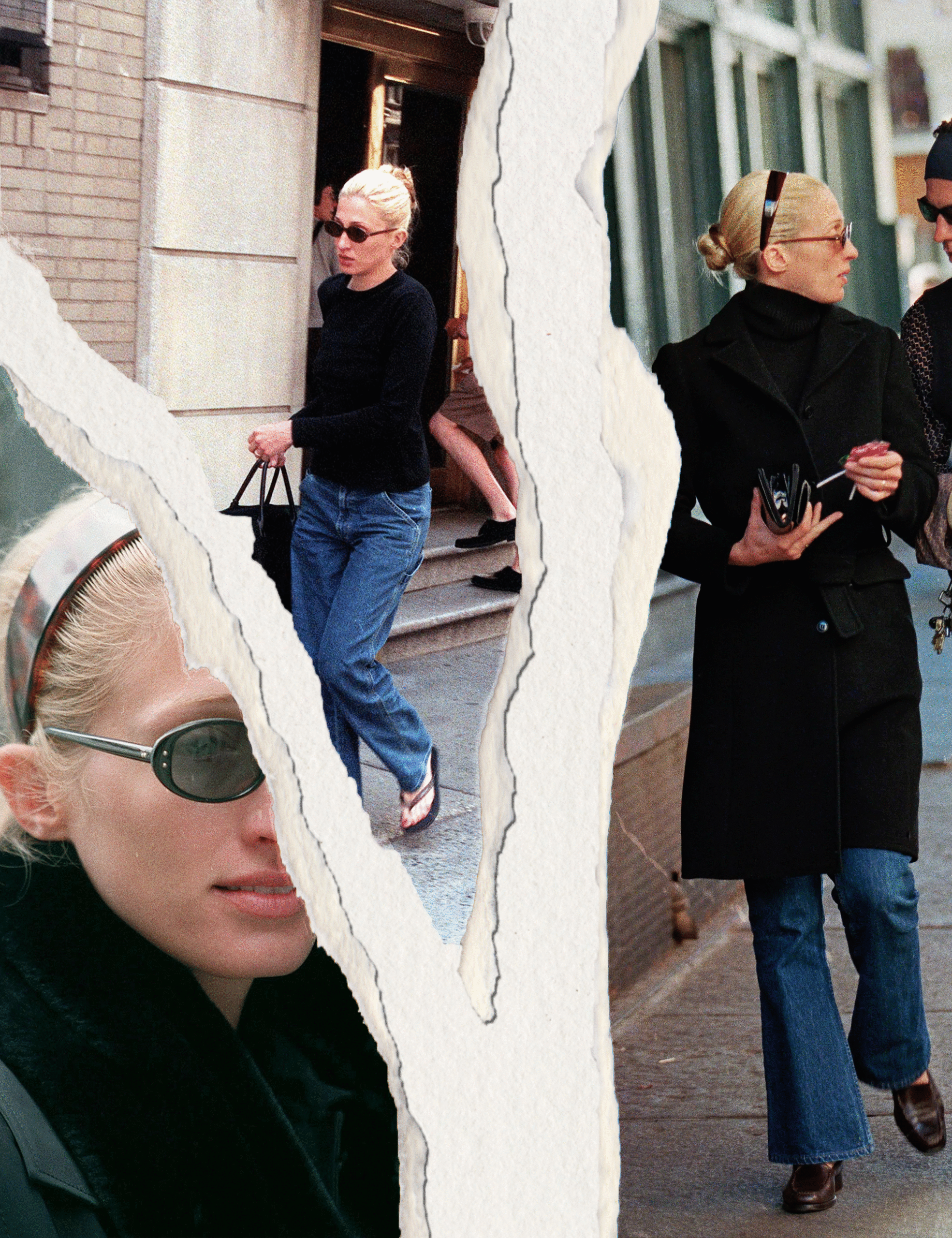
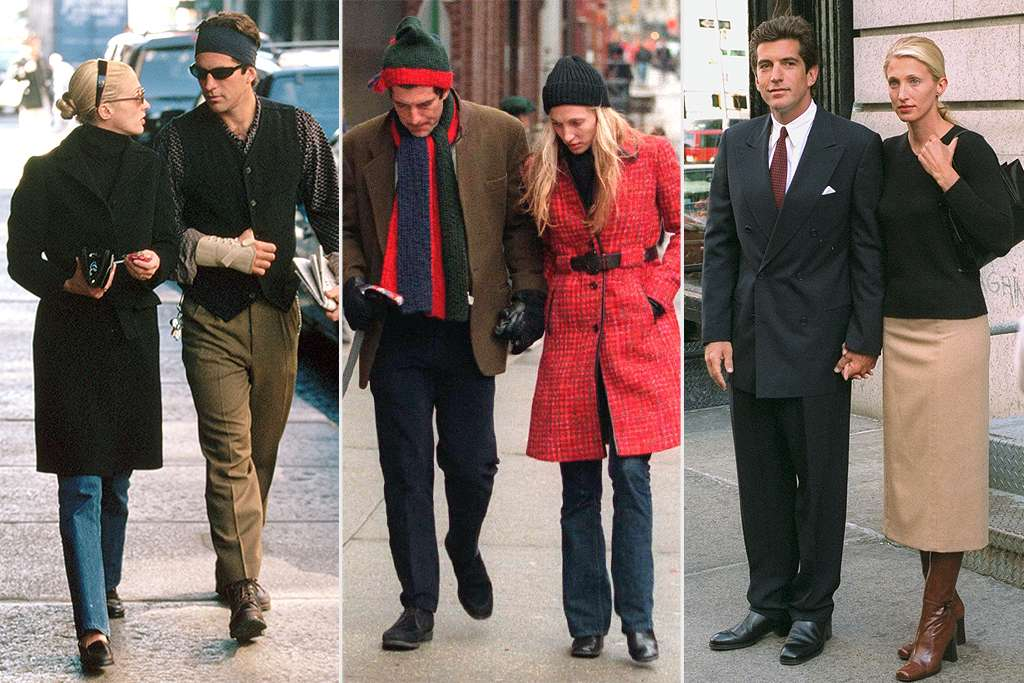
In the last few months, many of you may have noticed the recent explosion across Instagram, TikTok, Pinterest etc. about Carolyn Bessette-Kennedy and John F. Kennedy Jr. They reached my feed a little over a month ago; initially only small snippets, but within a week, it seemed impossible to avoid. The photos of Carolyn and John F. Kennedy Jr. appeared to be everywhere. Videos on TikTok broke down each outfit they wore; Pinterest boards recreated versions of their style; and the same photos were circulated repeatedly to the point of feeling familiar, which we can now see extending into contemporary fashion, as Calvin Klein recently released The 90s Edit, which revisits an aesthetic shaped in part by Carolyn Bessette during her time working there.
The timing is understandable, particularly after the release of Love Story, a new series directed by Ryan Murphy, which focuses on the biographies of JFK Junior and his wife, Carolyn Bessette-Kennedy. However, what struck me more than anything else was how quickly people’s fascination with them turned into an attempt to emulate them. As soon as there was curiosity about them, the attempts at mimicking them (in particular, a version of 90s minimalist fashion, that is heavily associated with them as a couple), emerged everywhere at once. Trends are always cyclical, nostalgia is always a driving force behind cultural trends, however, I do not recall it ever happening this rapidly. The distance between discovering something again and making it into a trend appears to be almost non-existent. It seems that the past no longer returns gradually, but rather it falls directly into the present.
I find the past does not fall into the present slowly, but rather drops suddenly into our daily lives. Alongside this rapid movement, I also see the conditions that make it possible. Social media may facilitate the spread of trends; however, it also determines which images ever get the chance to circulate, and how we relate to them. I am reminded of cultural critic Walter Benjamin, who spoke of “the aura,” the sense that an image has a direct connection to a specific moment and place. That aura, he argued, was lost once something was reproduced. What we are seeing now seems to be a further extension of this. Images are continuously reproduced. They are repeatedly removed from their origin and used again, until that origin becomes almost insignificant.
As such, what returns is not the fullness of the past, but one version of it. The case of Carolyn Bessette-Kennedy and John F. Kennedy Jr. illustrates this clearly, yet similar patterns appear across different aesthetics and eras. Regardless of the source, only what fits visually within the present, is recognizable, and can easily be translated into how people present themselves today, reappears. I do not think this is only about aesthetics, but about structure. Social media platforms (e.g., TikTok, Instagram) favor immediate communication; as a result, what spreads are images and ideas that can be quickly understood, copied, and recreated. The past begins to function more as a resource than as history. A resource is something that can be drawn from, shaped, and used in the present without fully understanding its origins.
I think this happens collectively because there has been a shared desire for a time that seems less mediated. There is a common idea (whether true or not) that the past existed before everything became constant, observable, and performative; before cell phones were ubiquitous, before everything became content. Therefore, older images are seen as having some sort of importance, even if the importance is likely mostly imagined. I see this not only in the images that people share with each other, but also in how people strive to recreate the feeling of being “in” the moment. For example, the resurgence of using analogue cameras, increased interest in film, and the growing popularity of physical media indicate a desire for a tangible experience that is less immediate and less easily duplicated.
Yet, our consumption of those images precludes us from experiencing that slowness. Even though we are able to use analogue cameras, the process of scanning and uploading them for online circulation makes them operate at the same speed as everything else. Aestheticized film becomes a visual effect that can be replicated digitally and thus loses any implication of a different relationship to time. We scroll through the images of the past at the same pace as we scroll through everything else: scrolling, saving, reproducing, and moving on. When we are drawn to aesthetics that imply a more grounded sense of reality, we are encountering them through systems that emphasize speed and reproduction. Therefore, the contradiction is that the past is represented as being slower, more substantial, perhaps more sincere than it currently is, while it is processed through systems that strip those characteristics away. The more that an image circulates, the farther away it is from its original context. As such, the image is eventually dislocated enough to be utilized without opposition. I have observed how quickly this occurs: something emerges, disseminates, is acknowledged, and is then exhausted. Trends are not only speeding up, they are no longer developing in the same manner as they did previously. Rather than developing and changing over time, they are circulating.
While the desire for a more authentic experience continually re-emerges in the form of new trends that purport to provide a return to the past, these too become rapidly assimilated into the same cycle. In doing so, what began as an effort to slow down or reconnect becomes something that can be shared, copied, and repeated. And, similar to the previous trend, as quickly as something begins to feel authentic, it is being disseminated. At a certain point, it is no longer perceived as something to return to, but rather as something to pass through. And the result? This new age of ‘digital’ nostalgia makes everything feel less like an actual return to the past, and more like something we pass through in speed.